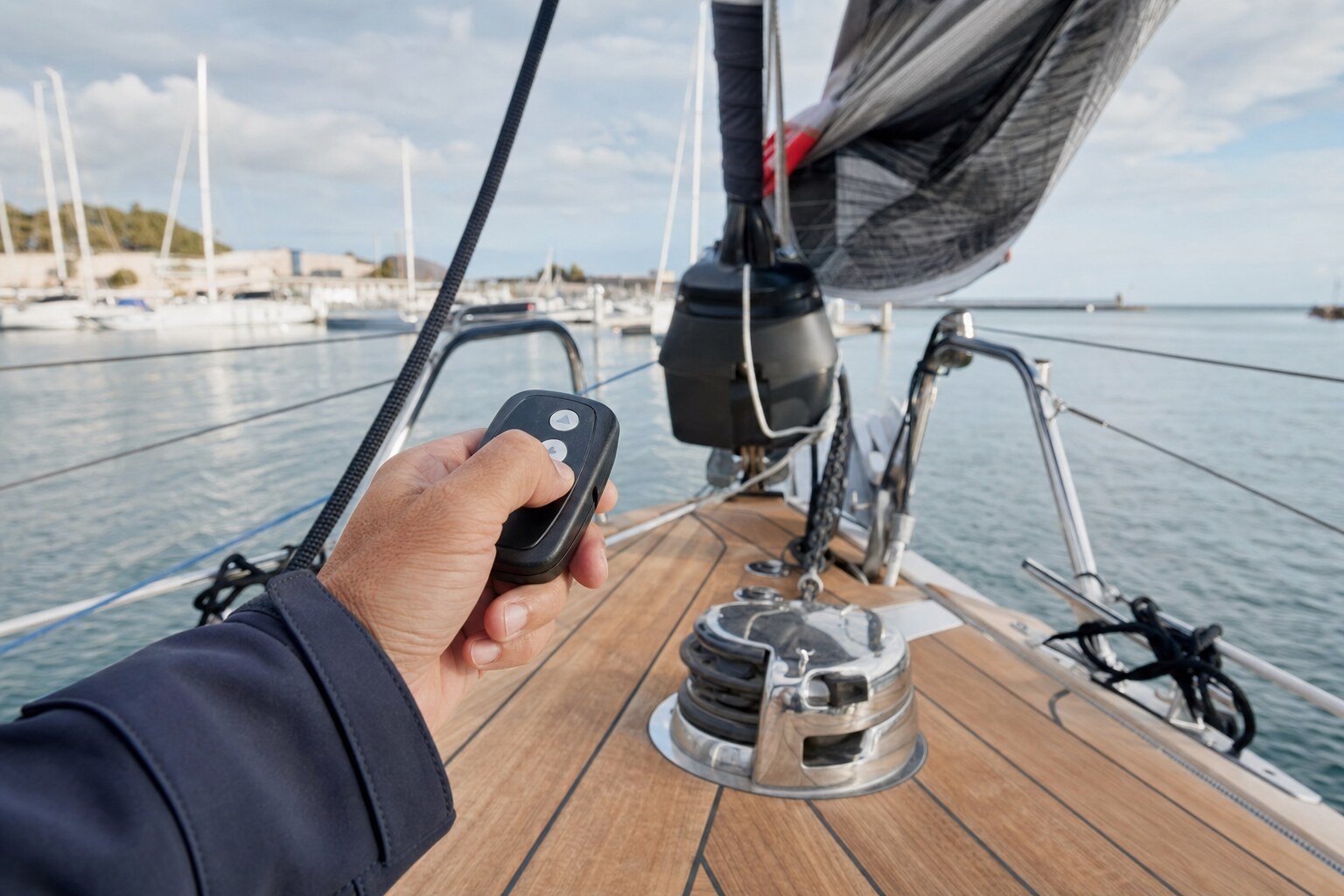



A junction box lets in water on a dirty night crossing, the wiring shorts, and the genoa is stuck half out with the wind building. That is a real account from a Furlex Electric owner, and it is the scenario every electric furler buyer should think through before they need it, not while it is happening.
Here is the part most owners get wrong: they assume "electric" means there is a crank handle or a backup line hiding somewhere on the unit, just in case. That is true for one of the three electric systems 123Furling sells, and it is not true for the other two. Which one you own changes what you actually do when the motor stops, and it should change what you check before you leave the dock.
"Electric" doesn't mean the same backup on every furler
Seldén sells two very different electric furling lines: the Furlex Electric for genoas and headsails, and the CXe for Code 0 and gennaker sails. Profurl sells the NEXe, an electric version of its manual NEX system. All three run on 12V or 24V boat power converted through a DC/DC unit to drive the motor, and all three will eventually see a bad connection, corrosion or a blown fuse somewhere in their working life. What happens next is not the same on any of them, and manufacturer marketing pages rarely spell that out side by side.
It matters more the further offshore you go. A coastal day sailor who loses the furler ten minutes from the marina can motor in and sort it out at the pontoon. A crew mid-Biscay with a jammed headsail and rising wind does not have that option, and that is exactly the situation the YBW forums keep coming back to when owners debate whether electric furling is worth the risk.
Seldén CXe: no emergency line, no crank socket
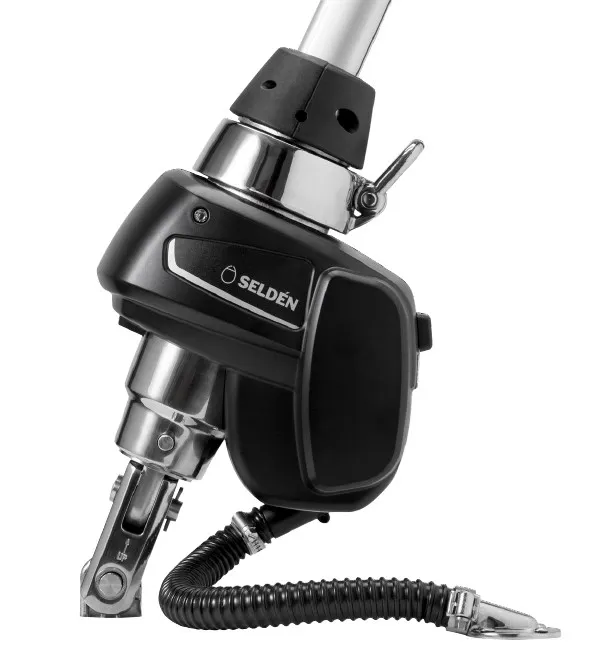
Open the CXe manual and you will find a chapter titled "Emergency operation" that says, in short, there isn't one. Unlike the Furlex Electric, the CXe does not ship with an emergency line-driver or a crank socket. If the motor stops with the Code 0 or gennaker unrolled, Seldén's own guidance is to reduce load rather than fight the drum: ease the sheet, get the sail blanketed behind the main at an apparent wind angle of roughly 90-120°, and bring it down on the halyard if it still will not roll away by hand.
This matters more on the larger of the two models than the smaller one. The CXe25 is rated for a maximum working load of 2,500kg and sail areas up to 115m², while the CXe45 covers 4,500kg and up to 200m². A 200m² gennaker that refuses to roll up by hand is a very different problem on a 55-footer than a 30m² Code 0 on a 32-footer. If you are speccing a Seldén CXe Code 0 On-Deck Electric for a boat at the top end of that range, plan for the fact that recovery is manual labour on the halyard and sheet, not a mechanical backup on the drum.
Seldén Furlex Electric: the emergency line-driver most owners never test
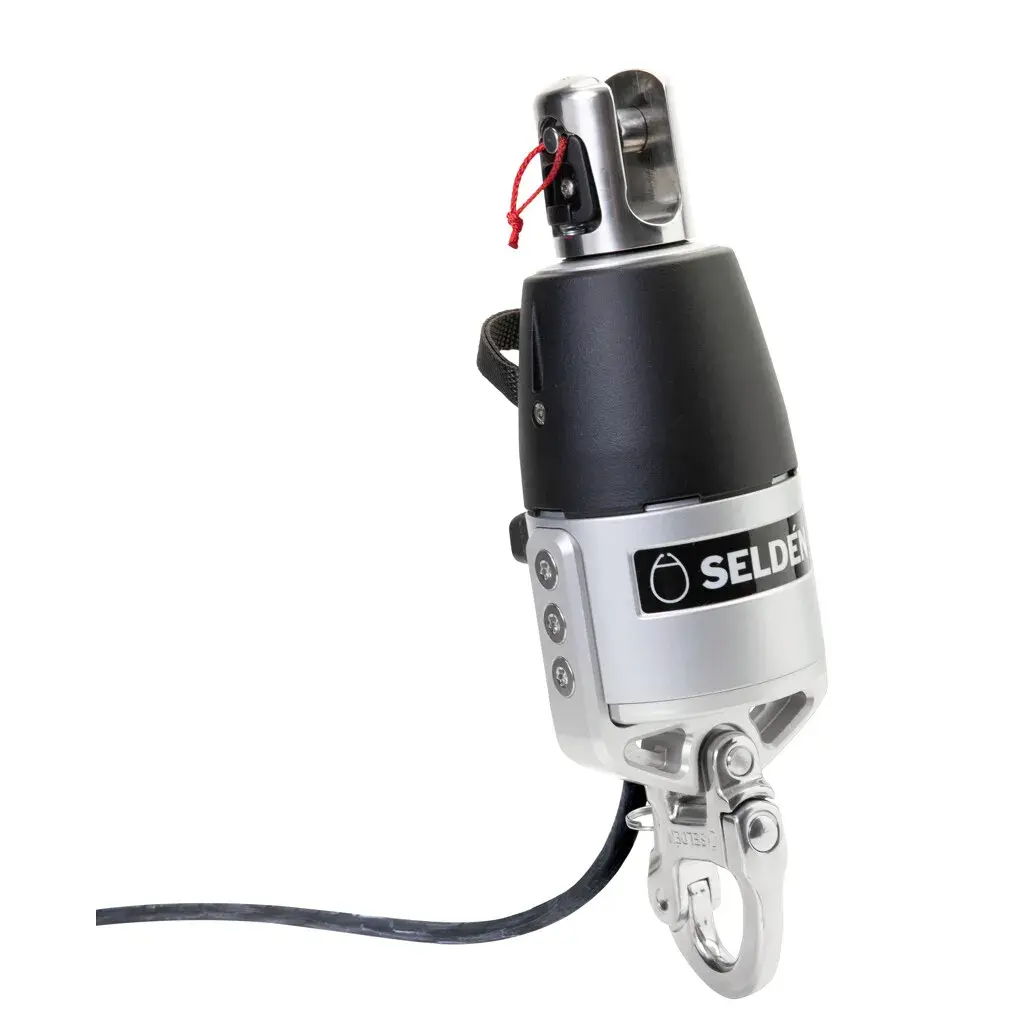
The genoa furler is built on a different philosophy. Furlex Electric (60 Nm on the 204E, 90 Nm on the 304E, up to 135 Nm on the 404E) drives through a self-locking worm gear at a 122:1 ratio, and Seldén specifically builds in a 40:1 emergency ratio for manual backup. An emergency line-driver ships as standard on both on-deck and through-deck versions, and an optional ½" socket handle lets you crank it directly if you would rather not pull a line. In practice, a genoa on a stalled Seldén Furlex Electric unit can still be furled by hand, just at a fraction of the speed and with real effort on a bigger genoa.
The catch is that most owners never touch the emergency kit until the day they need it, and by then they cannot remember where it is stowed or how the line-driver seats on the drive unit. It takes about five minutes at the start of the season to dig it out, fit it, and run one full furl and unfurl with it. Do that once and the emergency procedure stops being a mystery you are solving for the first time under load, at night, in a building breeze.
Profurl NEXe: the motor sits on a manual system, but that isn't the same as a manual override
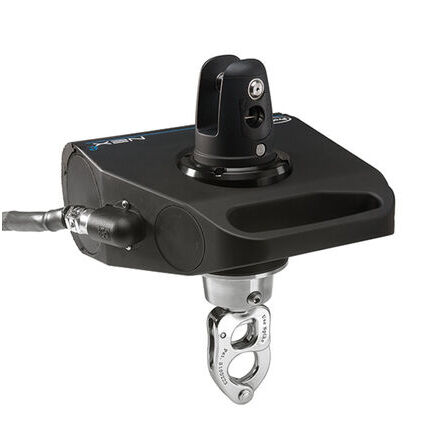
Profurl takes a third route. The Profurl NEXe is sold either as a complete system or as a motorisation kit that bolts a gear motor onto your existing manual NEX drum and swivel. That sounds reassuring on paper, the manual drum mechanics are still physically underneath the motor, but Profurl's published documentation does not describe a simple hand-crank path once the gear motor is fitted, unlike Seldén's clearly stated 40:1 emergency ratio on the Furlex Electric. Across the three power classes (NEXelite 4.0 at 4,000kg MWL, NEXelite 6.5 at 6,500kg, and NEXE 8.0 at 8,000kg for sails up to 300m²), that ambiguity gets more expensive to discover offshore the bigger the rig gets. Ask your rigger or Profurl directly to confirm the override procedure for your exact model in writing before you rely on it at sea, and until you have that answer, plan for a NEXe failure the same cautious way you would plan for a CXe failure.
Why the motor actually stops (it is rarely as dramatic as it sounds)
Total failures at sea are what generate the forum horror stories, but Seldén's own troubleshooting guidance for a non-operating furler starts somewhere far less dramatic: corroded or loose wires in the connection box, salt and dirt on the terminals, or a worn drive belt. A furler that sat through a wet winter with a poorly sealed junction box is a far more common failure than a burned-out motor, and it is exactly the failure mode behind that dirty-night story from the opening of this article. On the mechanical side, a jammed drum on a Profurl-based system is often a furling line that has overridden itself on the drum, sometimes worsened by a bad lead block causing chafe, not a motor fault at all. The fix in that case is the same whether the drum is manual or motorised: drop the sail, confirm the swivel spins freely, unwind the line by hand, and re-wind it with tight, even wraps before re-hoisting.
Rinsing the connections with fresh water, cleaning the terminals and re-greasing the drive unit at the start of the season catches most electrical failures before they become a mid-passage problem. We cover the gearbox side of that seasonal check in our electric furler maintenance guide, and it is worth doing alongside the electrical inspection, not instead of it.
How to actually prepare for it
If you own a Furlex Electric, find the emergency line-driver and run it once before the season starts rather than the first time you need it in a blow. If you own a CXe or a NEXe, accept from day one that manual recovery means easing the sheet and dropping the halyard rather than cranking the drum, and rig for that possibility. Some owners heading offshore add a removable inner forestay so a jammed or failed Code 0 furler is not the only way left to reduce headsail area in a blow. Keep a spare fuse of the correct rating and a basic multimeter aboard too, since a blown fuse or a corroded terminal is a five-minute fix at the dock and an unnecessary emergency-procedure situation at sea.
At 123Furling, this is the question we get most from owners upgrading from manual to electric for the first time: which backup mechanism, or lack of one, comes with the system they are about to buy. That should be part of the decision, not something discovered the first time the motor stalls offshore. Our comparison of electric furler brands covers torque and price differences if you are still choosing between systems.
Not sure which electric system fits your rig, or whether it ships with a backup line-driver as standard? Use our product advisor or send us your forestay length and sail area at info@123furling.com and we will match it to the right model.