


You are browsing the shop, looking for a new block for your sheet system, and you see three letters: BBB, PBB, RBB. Three series, three price ranges, three very different applications. But what is the actual difference? And more importantly: which type suits your boat and your style of sailing?
The answer lies in the bearing. The bearing is the heart of every block. It determines how smoothly the sheave turns, how much force the block can handle, and how it behaves under load. The wrong choice does not mean your block will immediately break, but it can mean you have to pull harder than necessary, that your block wears out faster, or that you are spending money on capacity you do not need.
The three bearing types in sailing blocks
In the world of sailing blocks there are three main bearing types, each with their own strengths. They are not better or worse than each other. They are designed for different situations.
Ball bearing blocks
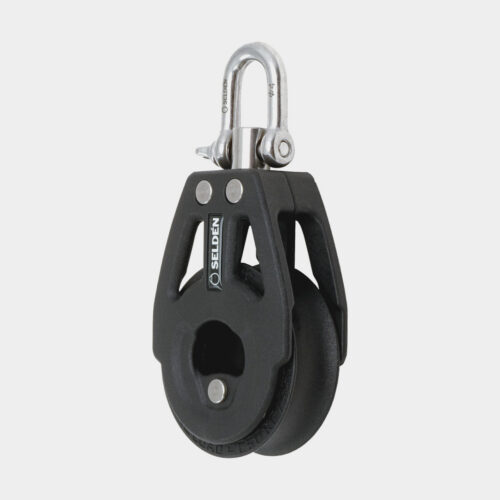
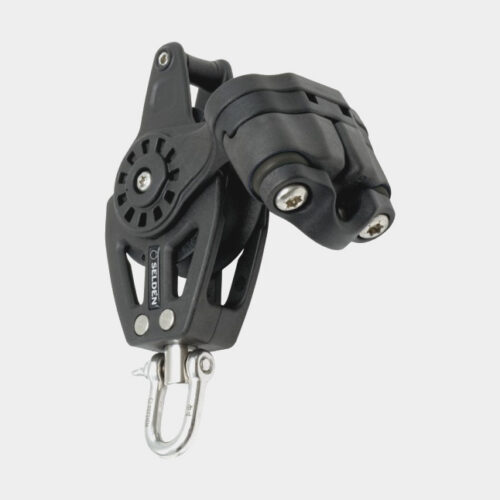
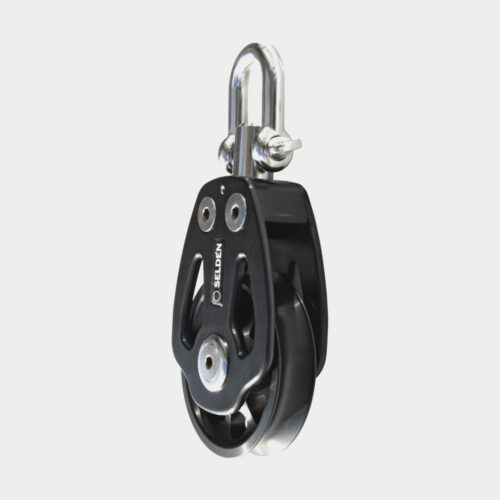
Ball bearing blocks, designated as BBB (Ball Bearing Blocks) in the Selden range, use stainless steel balls in an acetal cage. This is the most popular choice for most sailors, and for good reason.
The great advantage of a ball bearing is its extremely low friction. The balls roll freely between two stainless steel races, allowing the sheave to spin effortlessly, even under load. This makes them ideal for applications where you regularly adjust the line: sheets, trim lines, spinnaker sheets and other systems where you want to be able to ease and trim quickly and smoothly.
Where ball bearings are less strong is under constant, heavy static load. If a block is under high tension for extended periods without moving (think of a halyard that is loaded all day), then a ball bearing is not the most efficient choice. That is the domain of the plain bearing.
When to choose ball bearing:
- Sheets (jib, genoa, spinnaker)
- Trim lines and control lines
- Any application where you regularly adjust the line
- Light to moderate loads
- Situations where low friction matters more than maximum load capacity
The BBB series is available in sizes from 20 to 60 mm sheave diameter, suitable for lines from 2 to 10 mm. The cheeks are made of fibreglass-reinforced polyamide: lightweight, strong and resistant to seawater and UV.
Plain bearing blocks
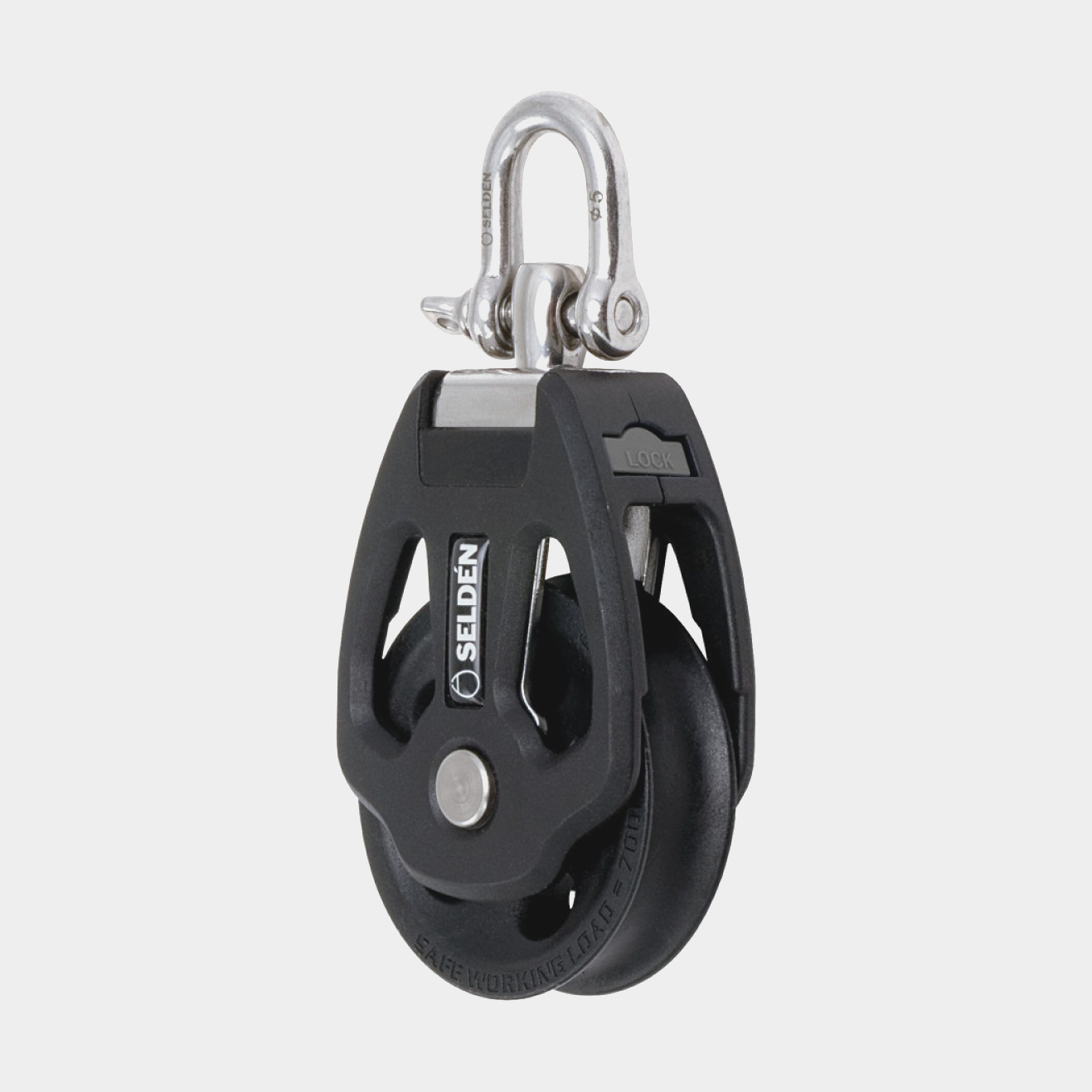
Plain bearing blocks, the PBB series (Plain Bearing Blocks), work fundamentally differently. Instead of rolling balls, a plain bearing has a smooth bushing (made of bronze or Teflon) through which the sheave axle rotates. There is direct contact between the axle and the bushing, hence the name "plain bearing".
This may sound more primitive, but it is precisely the strength of this design. A plain bearing can absorb enormous static forces without the components deforming. Where balls under extreme load can indent into their races, a plain bearing remains stable. This makes PBB blocks the first choice for heavy, constant loads.
The downside is that a plain bearing has slightly more friction at low loads than a ball bearing. You need to pull a bit harder to get the sheave spinning. Under load this difference largely disappears, but for applications where you are constantly making small adjustments, you will notice it.
The PBB series starts where the BBB series stops: at larger sizes and higher loads. With a safe working load from 350 kg (PBB 40) up to 4000 kg (PBB 100), these are the blocks for serious applications on mid-sized to large yachts.
When to choose plain bearing:
- Halyards (mainsail, jib, genoa) that are under tension for extended periods
- Boom vang / kicker systems
- Backstay tackle
- Any application with high, constant load
- Larger yachts with thicker lines (8-16 mm)
Roller bearing blocks
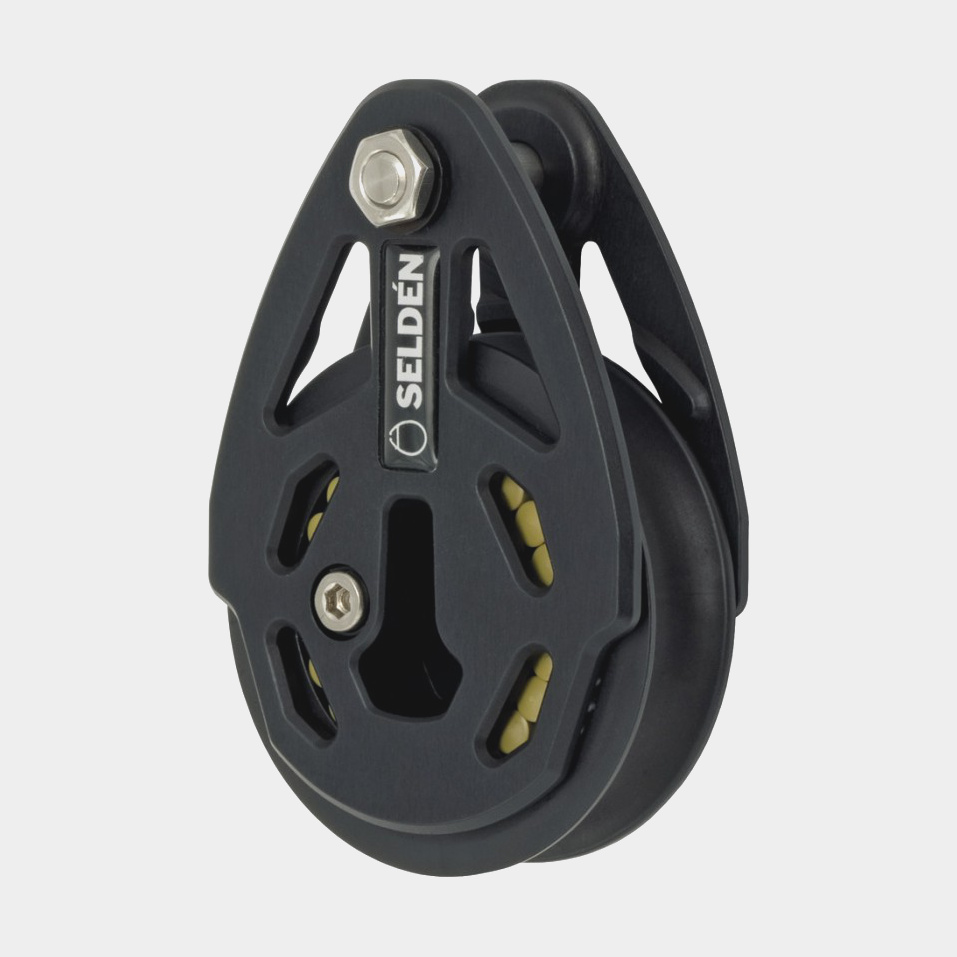
Roller bearing blocks, the RBB series (Roller Bearing Blocks), are the premium segment. They combine the best of both worlds: the smooth operation of a ball bearing with the load capacity needed for heavy dynamic forces.
The secret lies in the construction. The sheave runs on Torlon rollers (a high-performance engineering polymer) supported by acetal ball bearings for side loads. The sheave itself is made of black anodised aluminium. The result is a block that spins smoothly under enormous forces.
This makes RBB blocks the first choice for applications where you need to ease line quickly and smoothly under high, dynamic load. Think of quickly easing a backstay during a gybe, or dumping a spinnaker sheet in a gust. Where a plain bearing would give too much friction and a ball bearing cannot handle the load, the roller bearing excels.
The price reflects the complex construction: RBB blocks are considerably more expensive than BBB or PBB. But for racing sailors and owners of larger yachts where performance counts, the difference in operation is worth every euro.
When to choose roller bearing:
- Mainsheet systems on racing boats
- Backstay tackle that needs to be eased quickly
- Spinnaker and gennaker systems on larger boats
- Any application with high, dynamic load where speed matters
- Safe working load needed above 1500 kg
The three types side by side
| BBB (Ball Bearing) | PBB (Plain Bearing) | RBB (Roller Bearing) | |
|---|---|---|---|
| Greatest strength | Lowest friction | Highest static load | Smooth at high dynamic load |
| Ideal application | Sheets, trim lines | Halyards, vang, backstay | Racing mainsheet, backstay |
| Sizes (sheave) | 20-60 mm | 40-100 mm | 60-130 mm |
| Safe working load | Up to approx. 1000 kg | 350-4000 kg | 1500-5000 kg |
| Lines | 2-10 mm | 6-16 mm | 8-14 mm |
| Sheave material | Composite | Composite | Anodised aluminium |
| Price range | Entry to mid | Mid | Premium |
What about the S series?
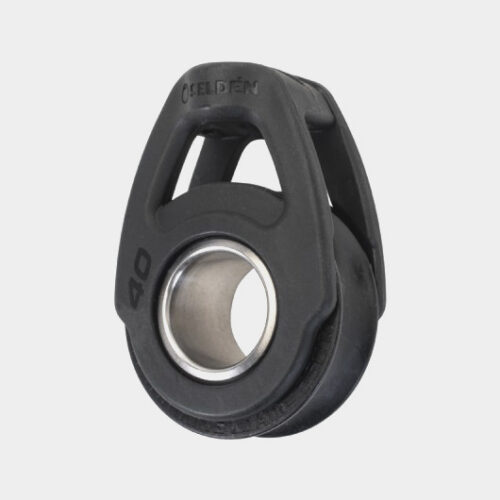
Besides the three main types there is the S series. These blocks use the same ball bearings as the BBB series, but are attached with a Dyneema loop instead of a metal D-shackle. The advantage? Weight saving. No stainless steel bracket or bolt, just a lightweight loop.
The S series is popular with racing sailors and owners of sporty yachts who count every gram. Performance is comparable to BBB, but total weight per block is lower. Available in sizes S20, S30 and S40.
Practical advice: which block where on your boat?
On most cruising yachts up to 12 metres you can get by with BBB blocks for your sheets and trim lines, and PBB blocks for your halyards and vang. A typical setup:
- Jib sheet turning blocks: BBB 30 or BBB 40 (depending on line diameter)
- Mainsail sheet purchase system: BBB 40 or BBB 60 double/triple blocks
- Mainsail halyard: PBB 50 or PBB 60 (under tension for extended periods)
- Boom vang: PBB 40 or PBB 50
- Spinnaker sheet blocks: BBB 40 or BBB 60 (dynamic, needs to ease smoothly)
On larger yachts (12 metres and above) sizes shift upward and the RBB series comes into play for the mainsheet system and backstay.
How to determine the right size
The two most important factors when choosing a block size are line diameter and expected load.
Line diameter determines the minimum sheave size you need. A sheave that is too small will pinch the line, causing wear and increasing friction. As a rule of thumb: the sheave diameter should be at least 6 to 8 times the line diameter for optimal performance.
Expected load determines the minimum safe working load (SWL) of the block. Keep in mind that forces in a purchase system are not equally distributed. The top block in a purchase carries more load than the bottom one. Always take a generous margin: choose a block with an SWL at least 50% higher than your calculated maximum load.
Conclusion
Choosing the right bearing type does not have to be complicated. Does the line move frequently? Choose ball bearing (BBB). Is the block constantly under tension? Choose plain bearing (PBB). Do you need the best of both worlds on a larger boat? Choose roller bearing (RBB). And do you want minimal weight? Choose the S series with Dyneema attachment.
Browse our complete range of single blocks or get in touch for personal advice on the right blocks for your boat.