

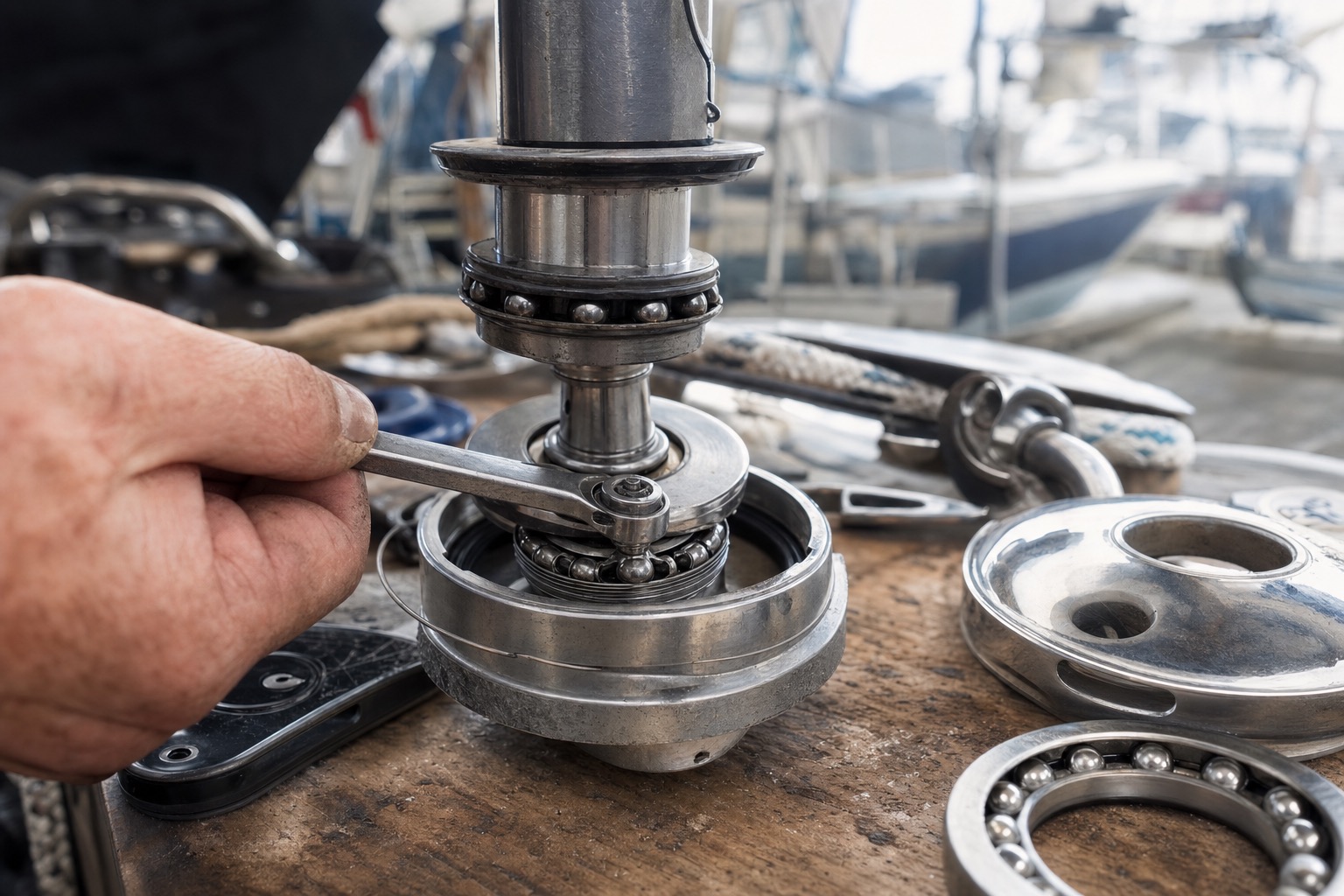
The first sign is almost never a jammed sail. It's subtler than that. You're furling in after a sail, the drum turns like it always has, but somewhere near the top of the forestay you feel a hitch, a spot where the line needs a bit more muscle before it lets go again. Most sailors shrug it off as a stiff halyard or a bit of salt build-up. Two seasons later the same furler locks solid halfway through a reef in 18 knots.
That hitch was the top swivel bearing telling you it was wearing out. By the time it jams completely, you're usually looking at a full swivel replacement instead of a 30 euro bearing kit that would have fixed it a year earlier.
What's actually spinning inside that swivel
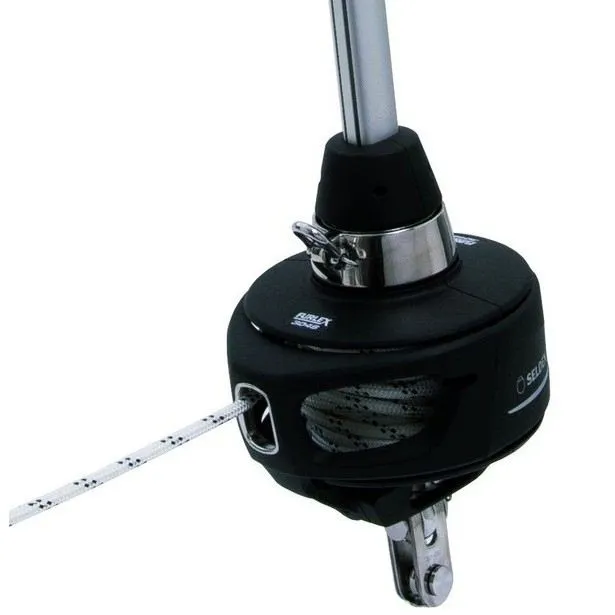
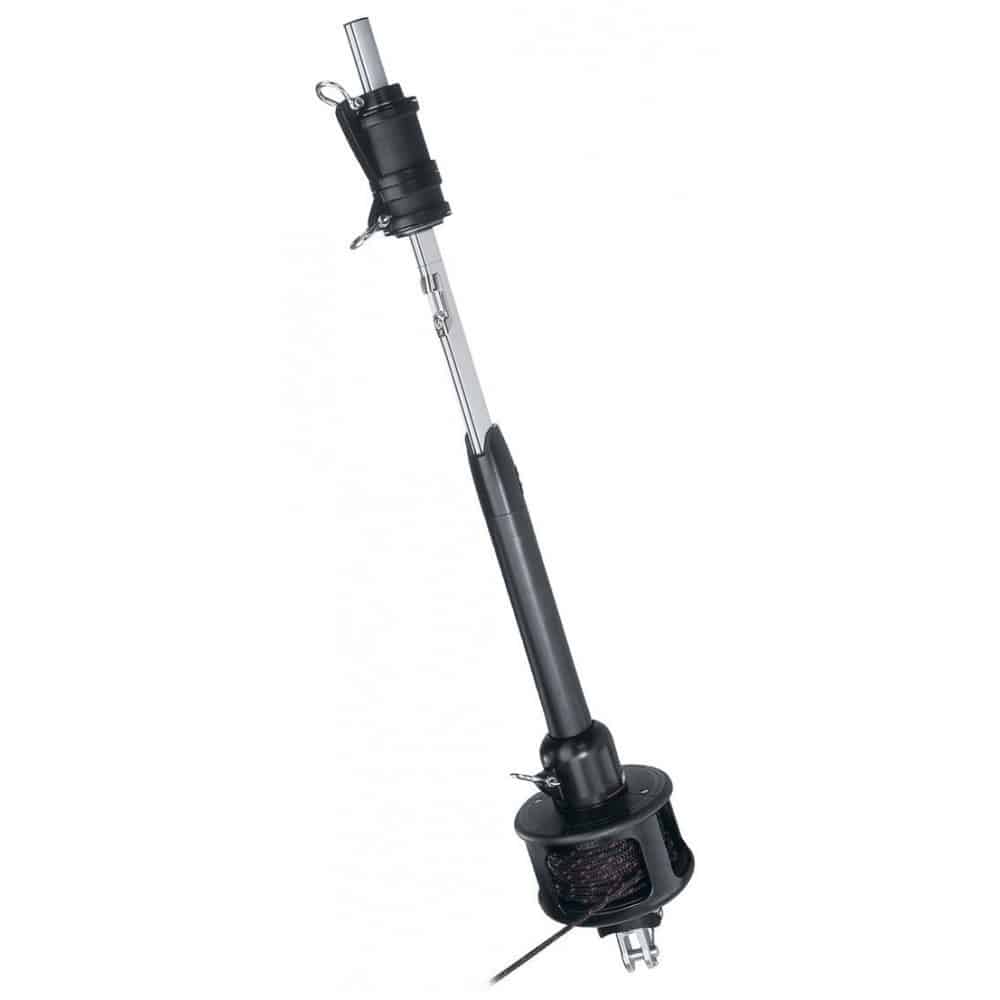
The top swivel is the part that lets the sail, halyard and forestay all rotate independently while the drum at deck level does the winding. Inside it there's a bearing race, and the type of bearing depends entirely on the brand.
Seldén's Furlex uses stainless ball bearings, four millimetres in diameter on the older 200 and 300 series, with the current 4th generation Furlex adding a second stainless ball race plus a roller bearing set to cut lateral deflection. Harken's MKIV uses a two-bearing system as well, a load-bearing race that takes the halyard tension and a smaller race that lets the swivel spin freely under low load. Profurl's older cruising furlers used sealed mild steel roller bearings, which is the one detail that matters most for older boats: mild steel corrodes once the seal fails, and a corroding bearing doesn't just get stiff, it seizes.
None of these are exotic parts. What kills them is the same thing across every brand: water finds a way past the seal, salt gets in, and the balls start pitting instead of rolling smoothly.
Reading the symptoms before they become a jam
The progression is fairly predictable if you know what to look for.
- Early stage: a slight catch or extra resistance at one specific point in the furl, usually near the top. The sail still rolls, but not evenly.
- Mid stage: the furling line needs noticeably more force, and you start to see the halyard fighting the swivel instead of settling straight down the forestay. This is often mistaken for halyard wrap, but the mechanism is different: wrap is the halyard climbing the foil, a stiff swivel is the bearing itself refusing to turn.
- Late stage: the swivel feels, as more than one sailor on the forums describes it, hydraulically locked. You can barely turn it by hand at the dock, let alone under load. At this point continuing to furl risks bending the swivel housing or snapping the halyard shackle.
If you're not sure whether your stiffness is a swivel problem or a wrap problem, we cover the difference in detail in our halyard wrap article. The short version: wrap happens fast, usually during a single hoist, and you can see the halyard spiralling around the foil. A swivel bearing failure happens gradually, over a season or two, and the foil stays clean.
The one habit that shortens a swivel's life by years
Leaving the genoa halyard tensioned hard all winter is the single biggest cause of premature bearing wear we see. Constant tension pins the bearing race against one side of its housing in one fixed position. Instead of the load rotating evenly across all the balls as you sail, it sits concentrated on the same few balls for months. Add condensation inside a boat cover and you get localised pitting exactly where the load sat.
The fix costs nothing: ease the halyard a few turns before you leave the boat for more than a few weeks, so the swivel isn't loaded in a fixed spot. Rotating the sail slightly during winter layup, if your furling line allows it, spreads the load further still.
Service kit or full swivel: what it actually costs
This is where the brands differ more than most sailors expect, and it's worth knowing before you call a rigger.
Seldén Furlex: the lower bearing components are cheap, in the 30 to 50 euro range per plug, and straightforward to swap yourself. The top halyard swivel is a different story. A genuine replacement halyard swivel kit for a Furlex 300-series runs well over 1,000 euros, because Seldén sells it as a complete pre-assembled unit rather than a bearing-only kit. On an older Furlex, replacing the whole swivel is often more cost-effective than trying to source loose bearings for it.
Harken MKIV: Harken publishes spare parts lists per unit size (Unit 0 through Unit 4), and individual bearing components are available separately rather than only as a full assembly. That keeps a straightforward bearing service noticeably cheaper than the Seldén route, though you need to identify your exact unit size first.
Profurl: a bearing refit kit for the C-series swivel runs in the 150 to 180 euro range, a fraction of a full replacement. The catch is availability: on older cruising models the mild steel bearings have sometimes corroded enough that the housing itself needs replacing along with the bearings, which pushes the job back toward Harken or Furlex pricing.
At 123Furling we get asked constantly whether it's worth servicing an older swivel or replacing it outright. Our rule of thumb: if the boat is under 12 years old and the bearing pitting is limited to surface rust rather than deformed balls, a service kit is worth trying first. Past that age, on a boat you plan to keep for years, a full swivel replacement is usually the better long-term spend, especially on Furlex where the bearing-only parts barely undercut the assembled unit anyway.
Do it yourself, or hand it to a rigger
Servicing the lower bearings on a Furlex, where the drum comes apart at deck level, is a job most owners with basic mechanical confidence can do themselves in an afternoon. The top swivel is a different job entirely: it usually means disconnecting the forestay, which means the mast loses its forward support until the job is done and the rig re-tensioned. That's not a job to improvise at the dock on a breezy day. If your furler needs the forestay disconnected to reach the swivel, get a rigger, or at minimum have someone experienced talk you through supporting the mast before you start.
If you're shopping for a full replacement rather than a repair kit, the Seldén Furlex and Harken MKIV System are both available on 123furling.com with the current bearing generation already fitted, and our brand comparison guide breaks down which one actually fits your boat size and sailing style.
Not sure whether your swivel is worth servicing or if it's time to move on? Send us the model and roughly how old it is at info@123furling.com and we'll tell you honestly which way to go.